Why Are There Different Types of Plastic?
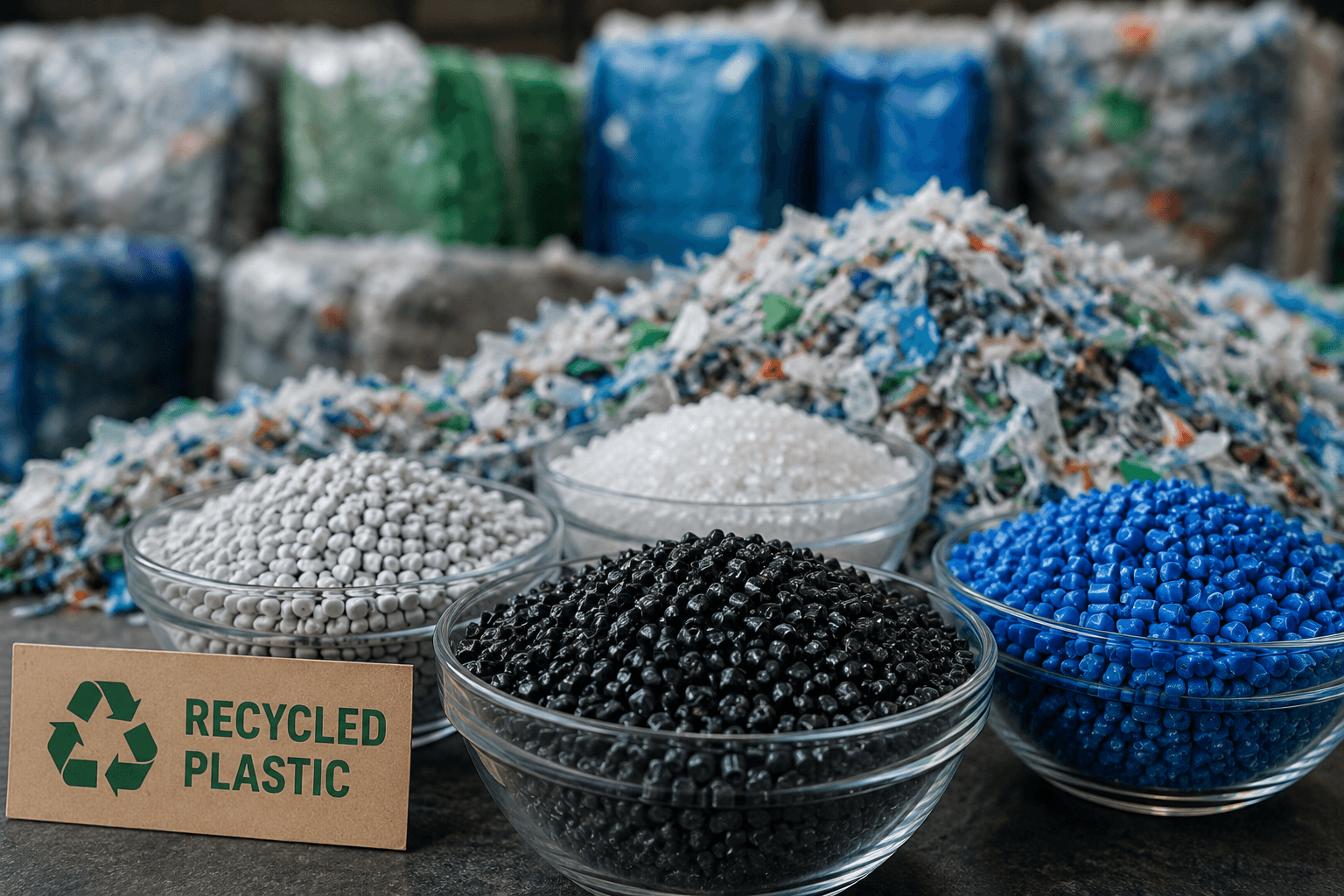
When people hear the word plastic, it can sound like there is only one material. In reality, there are many different types of plastic, each with its own chemical structure, properties, strengths, and uses.
A water bottle, automotive component, plastic pipe, food container, and industrial manufacturing part may all be made from plastic, but they can be made from completely different types of plastic.
Understanding these differences is also important when it comes to recycling. Different plastics require different processing methods, and not every plastic can be recycled in the same way.
What Makes Different Plastics Different?
Plastics are made from long chains of molecules called polymers. The structure of these polymers determines many of the properties of a plastic, including its:
- Strength
- Flexibility
- Durability
- Heat resistance
- Chemical resistance
- Transparency
- Density
- Melting and processing characteristics
This is why manufacturers choose different plastics for different products.
For example, polypropylene (PP) is lightweight and durable, making it useful for automotive components, containers, and many other manufactured products. High-density polyethylene (HDPE) is strong and resistant to many chemicals, making it useful for containers, pipes, and industrial applications.
Different plastics are engineered to perform different jobs.
What Do the Numbers on Plastic Mean?
You may have noticed a number inside a triangle on a plastic product. These are called Resin Identification Codes (RICs).
The numbers generally identify the primary type of plastic resin used to make the product. They help recyclers identify and sort different materials.
Importantly, the number does not automatically mean that the item is recyclable. A resin identification code tells you what type of plastic the item is made from; whether it can actually be recycled depends on factors such as the material, contamination, available processing technology, and local recycling infrastructure.
Here is a quick look at the seven commonly used categories.
#1 — PET: Polyethylene Terephthalate
PET is commonly used for products such as:
- Water and soft-drink bottles
- Food containers
- Some packaging
PET is widely used in consumer packaging and has established recycling streams in many areas.
#2 — HDPE: High-Density Polyethylene
HDPE is a strong and relatively rigid plastic commonly used for:
- Detergent bottles
- Shampoo bottles
- Containers
- Pipes
- Industrial products
HDPE is also widely used in manufacturing because of its strength and chemical resistance.
#3 — PVC: Polyvinyl Chloride
PVC is used in products such as:
- Pipes
- Flooring
- Window frames
- Cable insulation
- Certain packaging products
PVC has different properties from polyethylene and polypropylene, which means it requires different considerations during processing and recycling.
#4 — LDPE: Low-Density Polyethylene
LDPE is a more flexible form of polyethylene.
Common applications include:
- Plastic films
- Bags
- Flexible packaging
- Liners
- Squeeze bottles
Its flexibility makes LDPE useful for applications where a rigid plastic would not work as well.
#5 — PP: Polypropylene
Polypropylene, or PP, is one of the most widely used plastics in manufacturing.
It can be found in:
- Automotive parts
- Containers
- Packaging
- Horticultural products
- Caps and closures
- Industrial components
PP is also an important material in industrial plastic recycling.
At EPL Plastics, PP is one of the materials we commonly purchase and process. Depending on the material and its characteristics, PP scrap can be ground, densified, blended, compounded, pelletized, and returned to manufacturing applications.
#6 — PS: Polystyrene
Polystyrene, or PS, can be manufactured in several different forms.
It is used in products including:
- Packaging
- Containers
- Disposable food-service products
- Protective packaging
- Industrial applications
At EPL Plastics, polystyrene is another material we commonly process, including through densification and other recycling processes.
#7 — Other Plastics
The #7 category covers a broad range of plastics that don't fit into the first six categories.
This can include materials such as:
- ABS
- Certain polycarbonate materials
- Nylon
- Other specialty plastics
- Mixed or less-common resin types
Canada's Federal Plastics Registry, for example, separately identifies materials such as ABS, TPU, nylon, and other thermoplastic resins within its broader classification of plastics.
At EPL Plastics, we commonly work with materials including ABS and TPE, in addition to PP, PE, PS, and other industrial plastic materials. The suitability of a material for recycling depends on its specific characteristics, condition, contamination, and intended application.
Which Types of Plastic Does EPL Plastics Recycle?
EPL Plastics specializes in industrial plastic recycling and reprocessing.
We commonly purchase and process materials such as:
- Polypropylene (PP)
- Polyethylene (PE)
- Polystyrene (PS)
- ABS
- Thermoplastic elastomers (TPE)
- And other industrial plastic materials
Our processing capabilities include grinding, shredding, densification, separation, pulverizing, extrusion, pelletizing, blending, and compounding. Finished materials can be processed to meet specific customer requirements and returned to manufacturing applications.
Does EPL Plastics Recycle Post-Consumer Plastic?
Not currently.
As of today, EPL Plastics focuses on post-industrial plastic waste generated through manufacturing rather than post-consumer plastic collected from households.
There is an important difference between the two Learn More.
Why Understanding Plastic Types Matters
Knowing what type of plastic you are working with is one of the first steps toward determining how it can be processed.
Two pieces of plastic may look almost identical but behave very differently when heated or processed. Mixing incompatible materials can affect the quality and performance of the finished recycled product.
That is why proper identification, sorting, processing, and quality control are so important in industrial plastic recycling.
For manufacturers, understanding the resin they are generating can also help them make better decisions about how their production scrap can be recovered.
Plastic Is Not Just One Material
There is no single "plastic recycling process" that works for every type of plastic.
PET, HDPE, LDPE, PP, PS, PVC, ABS, TPE, and other polymers all have different characteristics and applications. Their differences are exactly what make plastics so useful across modern manufacturing.
Those same differences are also why responsible recycling requires the right knowledge, equipment, and processing methods.
At EPL Plastics, our focus is on helping manufacturers recover value from their industrial plastic waste by processing suitable materials into regrinds, densified materials, pellets, blends, and other recycled products.
As the industry continues to develop, improving the efficiency of the industrial recycling chain will be an important part of keeping more valuable plastic materials in use.
Frequently Asked Questions
What are the 7 types of plastic?
The seven resin identification categories are PET, HDPE, PVC, LDPE, PP, PS, and Other. The numbers identify the primary resin type and do not automatically indicate whether a product is recyclable.
What type of plastic does EPL Plastics recycle?
EPL Plastics commonly processes industrial PP, PE, PS, ABS, TPE, and other plastic materials, depending on the material's characteristics and processing requirements.
Does EPL Plastics recycle post-consumer plastic?
No. As of today, EPL Plastics does not recycle post-consumer plastic. EPL's current focus is on post-industrial plastic waste generated through manufacturing.
What is post-industrial plastic?
Post-industrial plastic is plastic waste generated during manufacturing. It can include production scrap, purgings, trim, off-spec material, and other manufacturing waste.
Does the number on plastic mean it is recyclable?
No. The resin identification number identifies the type of plastic resin. It does not guarantee that the item can be recycled through a particular recycling program.
Can different types of plastic be recycled together?
It depends on the materials and the intended application. Different polymers have different properties and processing requirements, so proper identification and separation are important for producing consistent recycled material.